In many industrial companies, training is still tied to traditional models: classroom sessions, a trainer in front of a screen, standard slide decks and a group of people who attend for a few hours to “receive” knowledge. It is a familiar picture, but it fits less and less with the operational reality of today’s industrial organisations.
Pressure to keep production running, staff turnover, the need to update knowledge continuously and increasingly complex processes all expose the limits of this approach.
Traditional training: concentrated in time and place
People have to meet physically, stop their work and spend hours or even days in training. If what they learn is not applied straight away, much of it is forgotten. And once the session ends, access to the knowledge usually disappears: the slides are filed away and the trainer is not always available.
Dependence on the trainer and the event
Learning quality depends on the person delivering the course. The same training is repeated several times, the message changes depending on who gives it, and knowledge lives in people rather than in the organisation. When someone leaves, part of that knowledge leaves too.
E-learning: from one-off training to permanent access
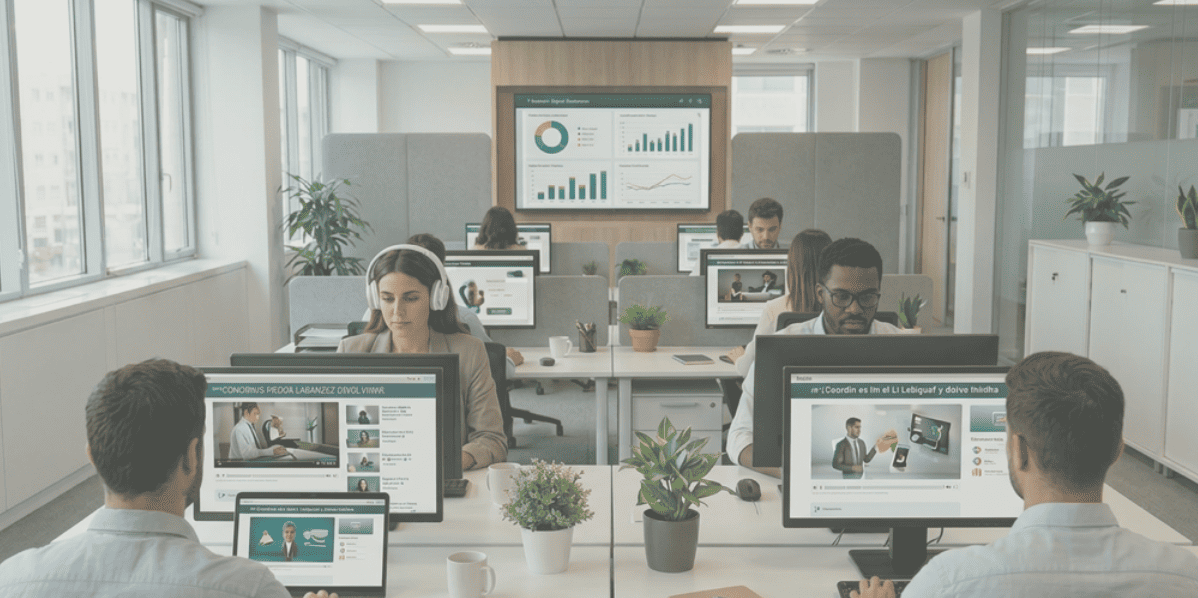
E-learning changes the logic: knowledge is no longer tied to a specific moment and is always available, from the workstation or anywhere else. Learning no longer depends on “having attended” a course, but on being able to look things up when a real question arises.
- Everyone learns at their own pace.
- Content can be reviewed as often as needed.
- Information is updated without repeating whole sessions.
The added value of 3D
In industrial settings, 3D models, technical animations, 360º environments and virtual or augmented reality let people see inside equipment that cannot be stopped, practise without risk and grasp complex processes at a glance. Training moves from an isolated event to a continuous learning system, connected to the product’s technical documentation.