
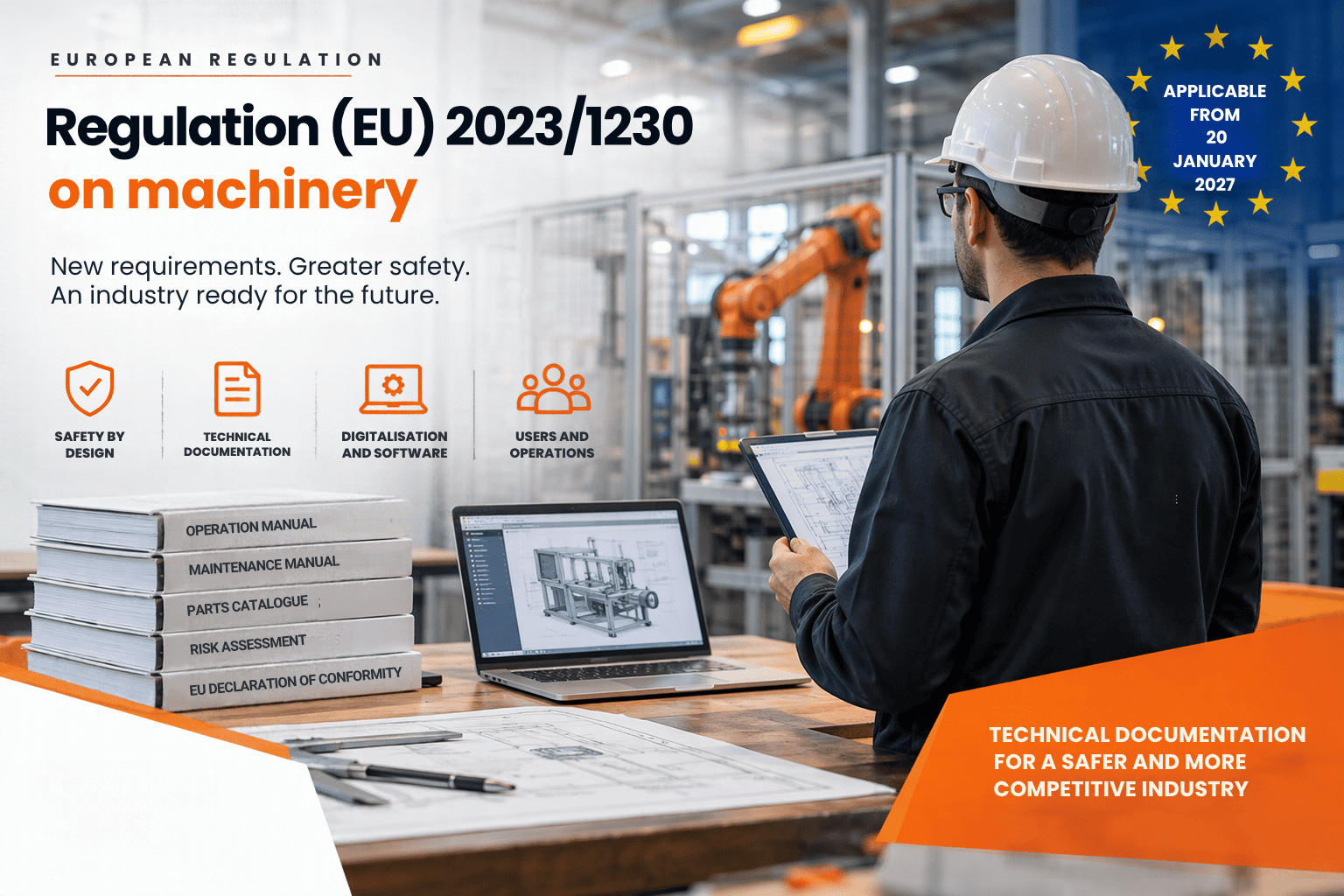
The EU Machinery Regulation 2023/1230 will bring a significant change for machinery manufacturers in the European Union from 20 January 2027. From that date, Regulation (EU) 2023/1230 on machinery will generally apply, replacing the current Directive 2006/42/EC.
This change responds, among other factors, to technological developments in recent years and to the need to adapt safety requirements to an increasingly digitalised, connected and automated industry.
For manufacturers, preparing does not simply mean becoming familiar with the new legislation. It is also a good opportunity to review risk assessments, technical documentation, instructions for use, the EU Declaration of Conformity and the way in which all this information is kept up to date throughout the machine’s life cycle.
What is Regulation (EU) 2023/1230?
Regulation (EU) 2023/1230 of the European Parliament and of the Council of 14 June 2023 establishes the new European framework for machinery and repeals Directive 2006/42/EC.
One of its objectives is to adapt safety requirements to the technological developments experienced by industry.
Today, a machine is no longer made up exclusively of mechanical, electrical or pneumatic components. Many machines incorporate software, connectivity, sensors, advanced automation and even systems capable of modifying their behaviour during operation.
The Regulation itself recognises the new challenges associated with digital technologies such as artificial intelligence, the Internet of Things and robotics.
For this reason, certain requirements and concepts relating to machinery safety and conformity assessment have been updated.
From a Directive to a Regulation: what does this mean?
One of the fundamental changes concerns the legal instrument itself.
Directive 2006/42/EC gives way to Regulation (EU) 2023/1230, with the aim of achieving a more uniform application of requirements throughout the European Union.
For manufacturers, integrators and other stakeholders, this makes it particularly important to have clear procedures relating to:
- risk assessment;
- technical documentation;
- instructions for use;
- conformity assessment;
- the EU Declaration of Conformity;
- CE marking;
- machine identification and traceability.
This does not mean starting from scratch. Many of the fundamental principles of machinery safety remain relevant.
The challenge is to determine what changes, what remains the same and how the new requirements affect each specific machine or product.
1. Digitalisation is also part of machinery safety
One of the most relevant aspects of the Regulation is the increased consideration given to digital technologies.
Software plays an increasingly important role in the operation of machinery and, in some cases, is also directly involved in safety functions.
The Regulation therefore provides for certain safety components to be digital and for software intended to perform a safety function and placed on the market independently to be considered a safety component.
This represents an important evolution in the way machinery documentation and safety are understood.
It is no longer sufficient to analyse only physical components.
Where applicable, software, its relationship with safety functions and potential planned developments throughout the product’s life cycle will also need to be considered.
2. Cybersecurity and machinery safety
Connectivity offers major opportunities for industry, but it also introduces new risk scenarios.
In a connected machine, digital interference could affect parameters or functions related to the physical safety of the machine itself.
For this reason, the new framework considers risks that may arise from malicious actions by third parties when they could affect product safety.
For manufacturers of industrial machinery, automated systems or connected equipment, this means reviewing the relationship between functional safety, software and connectivity.
Cybersecurity can therefore no longer be regarded as a completely separate issue when a vulnerability can ultimately affect the safe operation of a machine.
3. Digital instructions gain importance
Another change of particular interest to manufacturers and technical documentation departments concerns instructions in digital format.
The Regulation allows instructions for use to be provided digitally under certain conditions.
The manufacturer must indicate how they can be accessed and make them available in a format that allows users to download, save and print them so that they are available whenever necessary.
They must also remain accessible online for the period established by the Regulation.
This can represent an important opportunity for manufacturers that manage large quantities of documentation.
However, there is a fundamental difference between having digitised documents and professionally managing digital documentation.
Effective technical documentation should be:
- clear and understandable;
- accessible to the user;
- properly structured;
- easily identifiable;
- version-controlled;
- updateable;
- consistent with the actual product configuration;
- traceable throughout its life cycle.
Therefore, moving from a printed manual to a PDF should not be the only objective.
Digitalisation opens up the possibility of managing technical information much more efficiently.
In this context, EU Regulation 2023/1230 introduces new possibilities for managing and delivering instructions in digital format.
4. Technical documentation remains essential
Technical documentation will continue to play an essential role in demonstrating machinery compliance with the applicable requirements.
This is particularly important for manufacturers.
Drawings, diagrams, risk assessments, specifications, software-related documentation, instructions and declarations should not be managed as completely independent files.
Information must be consistent, up to date and traceable.
A design modification may affect a maintenance instruction. A component change may require changes to a drawing or parts breakdown. A software modification may require certain risks to be reassessed.
A sound documentation strategy should therefore make it possible to maintain the relationships between all this information.
Technical documentation should not be produced only at the end of a project in order to complete a technical file. It should accompany the product throughout its development and life cycle.
5. What happens if a machine is modified?
The Regulation also develops the concept of substantial modification.
In general terms, a physical or digital modification not foreseen by the manufacturer that affects safety, creates a new hazard or increases an existing risk may have significant implications if it requires significant new protective measures.
This is particularly important for machinery that remains operational for many years.
During this period, machines may undergo:
- retrofits;
- component replacements;
- control system changes;
- software updates;
- new automation;
- integration of additional systems.
Not every repair or maintenance operation automatically becomes a substantial modification. Each case will need to be technically assessed and relevant interventions properly documented.
This once again reinforces the importance of having up-to-date and traceable documentation.
6. Risk assessment and documentation traceability
Risk assessment remains one of the key pillars of machinery safety.
However, it should not be treated as an isolated document.
Good documentation makes it possible to establish a clear relationship between:
Hazard → Risk → Protective measure → Applicable requirement → Documentary evidence
When this traceability exists, maintaining documentation consistency following subsequent product modifications becomes easier.
It also enables engineering, quality, production, maintenance and documentation departments to work with consistent information.
7. What should manufacturers review before 2027?
Waiting until the last minute may mean having to review a large amount of documentation when deadlines are already tight.
It may therefore be advisable to begin with an assessment of the current situation.
Key aspects to review include:
- Identify which machines and products may be affected.
- Review existing risk assessments.
- Analyse the structure and content of technical documentation.
- Check instruction, operation and maintenance manuals.
- Review how different documentation versions are managed.
- Analyse documentation relating to software and safety systems, where applicable.
- Check traceability between design, risks, instructions and product configuration.
- Review the processes used when modifications are made to existing machinery.
- Assess how digital documentation is provided and retained.
- Determine which documentation will need to be updated before the new framework becomes applicable.
It is not simply a matter of creating new documents.
The objective should be to have a documentation system that makes it possible to know which documentation corresponds to each machine, which version is currently valid and what information needs to be updated when the product changes.
Preparing for EU Regulation 2023/1230 is not only about updating documents, but also about reviewing how the technical information associated with each machine is generated, structured and maintained.
How can we help?
The transition to Regulation (EU) 2023/1230 represents an opportunity to review not only documentary compliance, but also the way technical information is generated, organised and maintained.
At Geminys, we work with manufacturers and industrial companies on the development, structuring and management of technical documentation, with the aim of making information clear, up to date, reusable and useful throughout the product life cycle.
Geminys’ technical documentation services cover instruction, operation and maintenance manuals, parts catalogues, troubleshooting documentation, layout and publishing, translation, XML and 3D content.